What to Do if You Find a Marine Animal in Trouble
Call the emergency number, 112
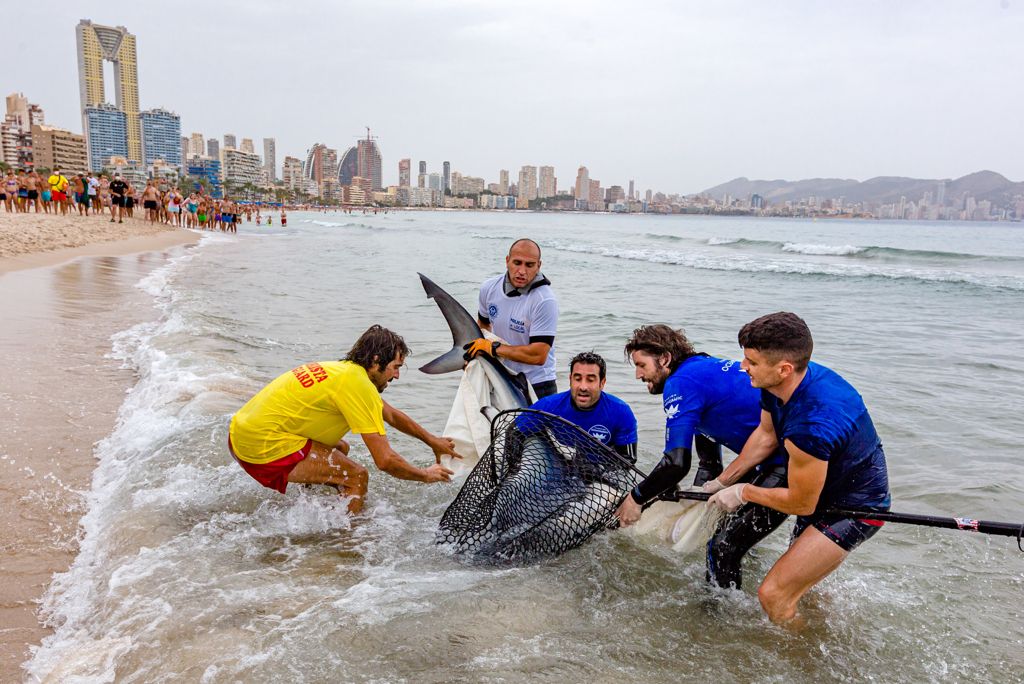
The Mediterranean Sea is home to many cetaceans, turtles, and sharks of great ecological value, which are responsible for maintaining the balance of the ecosystem. Some of them are seriously threatened, mainly due to the impacts caused by human activities.
Sailing or walking, you may find animals with problems, sick, injured, and even dead, so your collaboration is essential to protect marine fauna.
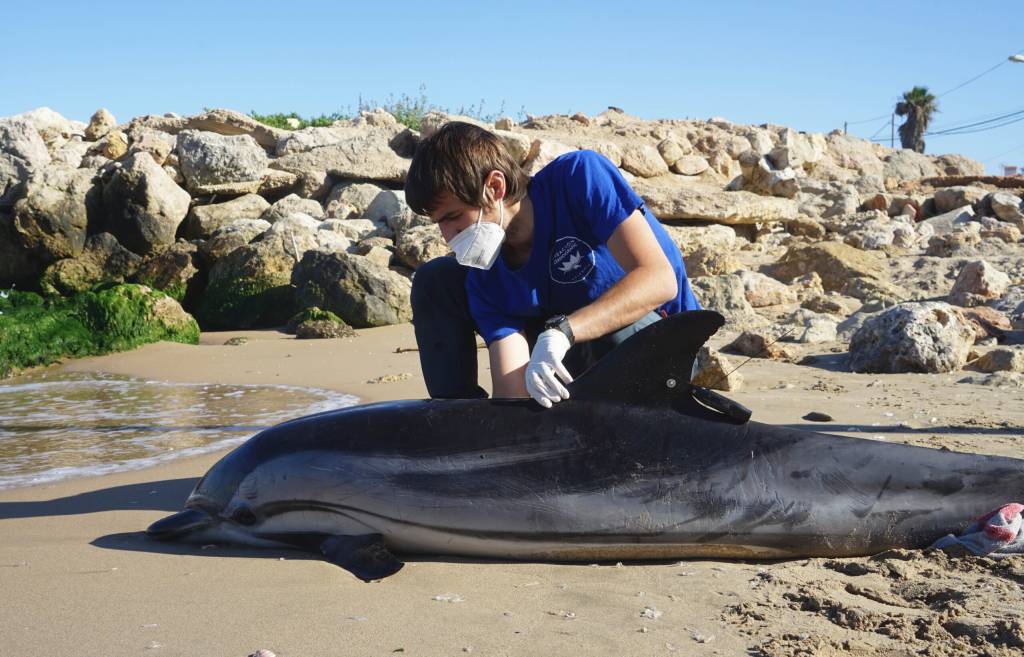
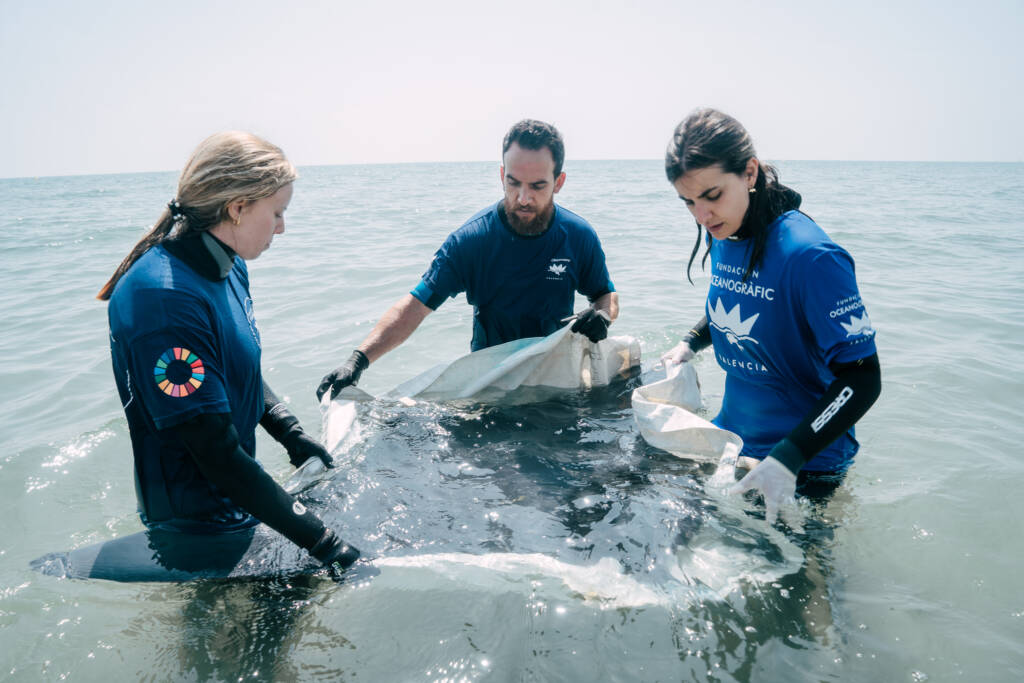
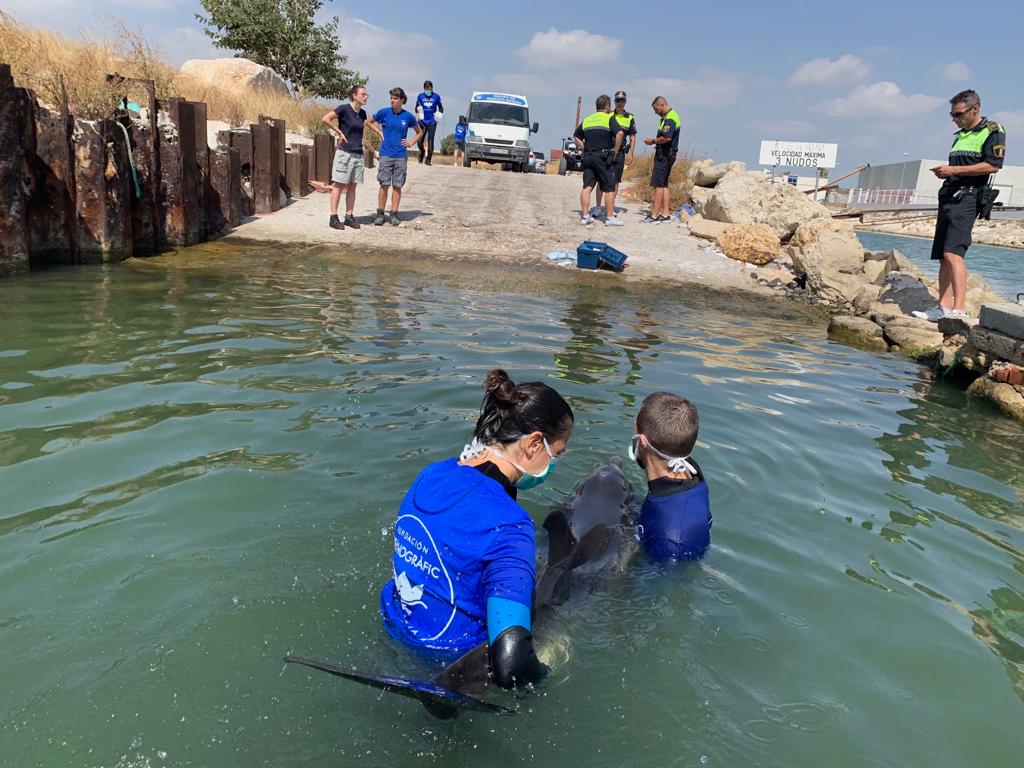
To do this, it is essential that you call the emergency number, 112, in order to activate the Stranding Network of the Comunitat Valenciana. Be patient before taking any action, as the rescue team of the Oceanogràfic Foundation and the Universitat de València will contact you to indicate the steps to follow.
When you find a marine animal in trouble
-
Do not enter the water
Do not enter the water to help or remove a drifting net that may have become attached to the animal.
This puts your life at risk.
-
Safety distance
Maintain a safe distance.
-
Do not feed or handle
Do not feed or handle the animal, as this may worsen its situation.
-
Avoid interfering
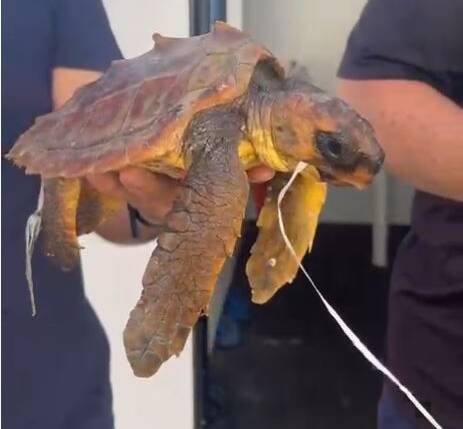
In the case of animals entangled in marine debris, do not remove the debris from the affected area.
-
Record information
Record as much information as possible.
Take photos, videos, and remember the time, position, and direction of the animal.
-
Observe
Try to identify the species. Its approximate size and weight, as well as its behavior.
Environmental practices
Consult the following manuals of good practice
-
Good environmental practices in marinas
1. Manage solid waste responsibly
This should be stored and disposed of in the places indicated in the port.
2. Do not pour liquids into the dock waters
Do not pour liquid waste of any kind into the dock waters. To do so, use the designated clean points in the port.
3. Avoid leaks
Avoid leaks and be very careful when handling oil and hydrocarbons. These form an impermeable layer with water that hinders the passage of sunlight and gas exchange with the marine environment. Inhalation or ingestion is very toxic to marine fauna.
In addition, it can cover the skin, gills, or feathers of animals, causing serious health problems.
4. Biodegradable cleaning products
The cleaning products that enter the gray water produced on the boat must be biodegradable.
5. Use phosphate-free detergents
6. Use biodegradable and solvent-free cleaning products.
7. Repairs in designated areas.
Boat repair or maintenance operations should be limited to the areas specifically designated for this purpose, in order to prevent toxic substances from entering the marine environment.
8. Use tin-free antifouling paint.
-
Good environmental practices on boats
1. Do not throw waste into the sea.
They injure, poison, can be ingested, cause asphyxiation, or impede the mobility of fauna.
2. Respect anchoring restrictions.
Use mooring buoys whenever possible. When anchoring, avoid seagrass beds (such as Posidonia oceanica), as they are breeding and refuge areas for species.
3. Moderate the speed of the boat and do not make sudden changes.
Moderate the speed of the boat and avoid making sudden changes in direction and speed. This will reduce noise pollution and possible collisions with fauna.
4. Know and respect the regulations.
Know and respect the regulations of activities in marine protected areas (MPAs).
5. Practice aquatic activities in a sustainable, responsible, and respectful manner.
Do not feed, disturb, touch, or collect animals and plants or live or dead algae.
6. Practice sustainable, responsible, and respectful recreational fishing.
If you practice recreational fishing, do so in a sustainable, responsible, and respectful manner towards marine fauna.
For example, do not use stainless steel hooks; if they get stuck in a fish’s mouth, it would take a long time to fall out. Avoid the use of lead as ballast, as it is very toxic if lost at sea, and there are harmless options such as zinc alloys or similar.
Consult various sources of information and stay updated with new techniques, implements, and accessories for responsible fishing.
-
Good environmental practices in marine fauna sightings
-
1. Exclusion Zone (0-60m).
Entry or stay prohibited.
2. Restricted Stay Zone (60-300 m).
Maximum of two boats simultaneously.
Entry prohibited if isolated adult specimens with young or isolated young are found.
3. Approach Zone (300-500 m).
Only a maximum of two boats may remain waiting to enter the Restricted Stay Zone.
4. Aerial Zone (0-500 m altitude).
Staying is prohibited.
5. Submarine Zone (0-60 m depth).
Staying is prohibited.
-
1. Physical contact with cetaceans.
Physical contact of boats or people with cetaceans.
2. Feeding animals or throwing waste.
3. Impeding or limiting the movement of cetaceans.
Impeding the free movement of cetaceans, intercepting, cutting off, or crossing their path.
4. Separating or dispersing the group of cetaceans.
5. Producing noises and sounds to attract or repel them.
6. The use of sonar and/or acoustic systems.
7. Reversing or sailing in circles.
-
1. Gentle approach.
Approach gently and convergently with the direction of the animals’ swimming at an angle of 30º.
2. Maintain parallel trajectory.
Maintain navigation on a parallel trajectory, without making sudden changes in course or speed.
3. Constant speed.
Constant speed, not exceeding four knots and, where appropriate, no faster than the slowest animal in the group.
4. Wait in neutral.
If the engine is switched off, when it is switched on, a neutral or disengaged position will be maintained for a minimum of one minute.
5. Leave the place.
Leave the place if the animals make sudden changes in direction and swimming.
Mobile cetacean protection space
The following is prohibited in the mobile cetacean protection space
In case of approaching animals
-